Article
Mapping Care in Contemporary Discourse: A Syllabus of Syllabi
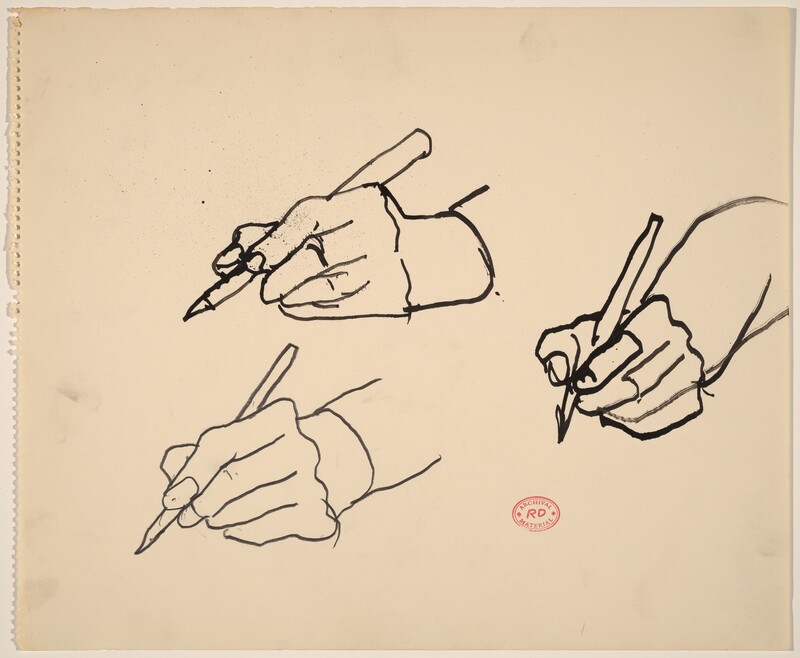
Untitled [three studies of a hand holding a writing tool], 1955-1967, Richard Diebenkorn
Stable Gestures draws on the growing contemporary discourse on the aesthetics and ethics of care, with a particular focus on writing at the intersection of theory and (art) praxis. As care has increasingly entered scholarly and popular discourse, especially in the wake of the COVID-19 pandemic, it has become a method and topic of investigation for artists as well as academics. We are especially interested in this meeting of fields and writing that is critical, reflexive, applied, explorative, and speculative in style and content.
Here we provide a short overview of key reading resources that we have found informative and which others interested in learning about care may find useful. It gathers syllabi of foundational texts, contemporary handbooks, and curatorial frameworks that Stable Gestures draws on — not to provide a comprehensive overview, but to mark the research already underway into which this platform seeks to enter.
Among the contemporary individual essays that have been influential in shaping the concerns of Stable Gestures are: Michael Stone-Richards’ Care Comes in the Wake of Retreat (e-flux Architecture, 2017); Anoop Nayak’s Decolonizing Care: Hegemonic Masculinity, Caring Masculinities, and the Material Configurations of Care (Men & Masculinities, 2023); iLiana Fokianaki’s The Mother Is Dead, Long Live (m)Othercare: Care as Alterity, an Introduction (e-flux, 2025); and Valeria Graziano, Marcell Mars & Tomislav Medak’s, Pirate Care: Acts Against the Criminalization of Solidarity (Pluto Press, 2025).
A recent contribution to medical care discourse comes Stable Gesture Contributing Advisor, Mehrunisha Suleman, who has co-edited Anti-Racist Medicine, a first-of-its-kind textbook that examines how race and ethnicity have influenced clinical care, research and medical education, and how to deliver anti-racist healthcare.
e-flux Reader on Care
Collection / Essays
Assembled by e-flux journal, this reading list gathers essays from across its publishing history that touch on care as artistic, political, and philosophical problem. The selection spans ruminates on viral care and collective care within cultural institutions (iLiana Fokianaki), intimate bodies, healing, and vulnerability (Irmgard Emmelhainz, Zdenka Badovinac) and love and feminism (Maria Lind).
How can care be an interdependent modality? What is the role of ongoing care in these times of crises? Can we orchestrate a collective closeness through systems of care?
Pirate Care - Syllabus: Situating Care
Platform / Recommended books, essays, and more
Developed as part of the Pirate Care collective research project, this syllabus situates care through four interlocking frames: care ethics (Tronto, Gilligan, Held), care of the self (drawing on Foucault and Black feminist traditions), caring as a way of knowing (epistemological dimensions), and care labour and social reproduction (feminist political economy). Each section provides introductory readings, key texts, and further resources — making it one of the most pedagogically rigorous entry points into the field.
The term care can refer to a broad variety of activities and hold different meanings for different people. And yet, all depend on its provision to some extent, all practice it , albeith in widely different conditions, and all experience its effects, in negative and positive ways
Pirate Care Syllabus: Situating Care
The Bureau of Care - Handbook
Programme / Collected essays
Founded by curator iLiana Fokianaki, The Bureau of Care was an interdisciplinary research programme engaging with the ethics and politics of care through art. Its Handbook — a series of published essays, panel discussions, and encounters — develops a sustained investigation into the collective, reparative, and institutional dimensions of care. Across twelve documented encounters, the Bureau brought together communities, artists, and institutions in practices of care that resist commodification and individualism.
The diminishing of care in all facets of human life has been one of the major effects of neoliberal austerity policies, that was made even more visible during the global pandemic of Sars-Covid19.
Care Ecologies - Care in Conflict: Artistic Reflections on Broken Worlds/Words
Project / Collected essays
Care Ecologies is a European research and artistic project that maps the intersections of ecological thought and care ethics — exploring how ecosystems of dependency and maintenance challenge anthropocentric assumptions in both art and policy. The publication Care in Conflict: Artistic Reflections on Broken Worlds/Words, published by Idensitat, gathers artistic responses on the topic of care.
This publication seeks a rupture with the way we speak, taking language-as-care as the starting point for a reflection on what could critically resist the emergence nowadays of “care” both as abuzzword in the contemporary cultural scene and as an, often aestheticised, representation in various artistic and theoretical contexts.
Care Ecologies · Care in Conflict
Medical Humanities - Narratives of Care, Caring Materials, and Materializing Care in the Nineteenth, Twentieth, and Twenty-first Centuries
Project / Special Issue of academic articles
The Journal of Medical Humanities collected a Special Issue in 2025 on Narratives of Care, Caring Materials, and Materializing Care in the Nineteenth, Twentieth, and Twenty-first Centuries
As noted in the Introduction to the Special Issue, “we highlight materiality, illustrating how the clay’s texture symbolises the connection between humans and the more-than-human in nurturing environments. As Maria Puig de la Bellacasa (2017) notes, touch has a ‘unique quality of reversibility, that is, the fact of being touched by what we touch, puts the question of reciprocity at the heart of thinking and living with care’ (20). This special issue echoes de la Bellacasa’s understanding of tactile care as it unravels how stories and narratives shape our understanding of materiality, objects, and touch in forming relational bonds” (Joshi and French, 2025)
Journal of Medical Humanities Special Issue on Caring Narratives
Care in Policy
Care: A Review of the Literature
The Handbuch Sorgearbeit, Sorgebeziehungen und das Recht (Caring and the Law) provides chapters on how care has been applied in and by policy and law and what the analysis of care-related policy reveals about the welfare state and gender cleavages.
The chapter Care: A Review of the Literature is particularly instructive, as it demonstrates the popularity and depth of a care lens for understanding developments in a range of spheres, but it also reveals very different roots and tendencies in different approaches to care. It emphasises, therefore, the need to clarify terms and scope when one is using the concept of care and that it is imperative to take stock of how the concept is being used by others, especially as research and policy reform are proceeding rapidly.
Art & Care — From Crisis to Creativity
Project / Special Issue of academic articles
The Art & Care platform is a collaborative research platform across arts education and healthcare founded by Elena Cologni and Merel Visse, culminating in a special issue of the International Journal of Education and the Arts — open access, and gathering more than thirty artist-academics on care as a transformative practice.
To find new pathways, the project aims at collecting, sharing, and learning from interdisciplinary projects from two perspectives: creative research and care ethics. More specifically these will be discussed in terms of impact in society through social responsibility, creativity, and innovation coming from practices of care for the environment, society, heritage and art
Care Ethics Research Consortium (CERC)
Consortium / List of references
The Care Ethics Research Consortium is an international academic network dedicated to the scholarly development of care ethics as a research field, founded by Carlo Leget and Joan Tronto. The Consortium’s conferences and publications provide instructive insight into the development of contemporary care ethics as field of academic scholarhip.
The Care Ethics Research Consortium (CERC) is an international network of care ethics researchers from around the world. We study the theory and practice of care ethics, exploring the meaning and role of care in various social contexts.
Care Ethics Research Consortium
This syllabus will be updated as the Stable Gestures platform develops. It is not the territory nor the map, rather it is a set of guideposts we are using to develop our ideas.